

Here are some frequently asked questions about robotic welding
Have a question of your own?
Please get in touch
+44 (0)2476 393889
sales@unifabs.eu
Robotic welding services deliver numerous advantages over manual welding services:
It minimises health and safety risks: Robotic welding reduces the exposure of workers to hazardous fumes, intense heat, and ultraviolet light, significantly lowering the risk of injuries and health issues commonly associated with manual welding.
Robotic welding improves quality and consistency in production: Automated welding systems provide precise control over parameters, resulting in uniform welds that enhance product quality and reduce defects or inconsistencies across production runs.
Greater throughput can be achieved: Robots can operate continuously without breaks, allowing for faster production cycles and higher output compared to manual welding, which can be limited by the physical constraints of human workers.
It is more efficient and cost effective for complex and repeating components/assemblies: Robotic welding systems are ideal for handling intricate weld patterns and repetitive tasks, delivering consistent results with reduced labour costs and material waste over time.
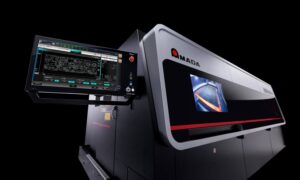
Unifabs runs a twin cell set-up which also carries its own advantages. In one cell the robot can be busily welding, whilst the operator is busy setting up the next job in the other.
Robotic welding brings a host of advantages in terms of safety, quality, efficiency and productivity, but it is not without its limitations.
Some of the disadvantages associated with robotic welding are:
Investment in equipment: Robotic welding systems require significant upfront investment. While you may recover the costs over the long term through savings in labour and materials, the short-term cost can be prohibitive.
Flexibility: Robot welders are perfect for repetitive work at medium to high volumes. However, if you need to manufacture a variety of work, reprogramming the robot takes time. For this reason volumes pose a limitation. If quantities are too small the set-up and programming time for a job could actually take longer than welding the job manually. This would make it cost prohibitive.
Risks of reliance on technology: If your robot welder breaks down, it could impact your production and deliveries while waiting for repairs. For these reasons Unifabs does not solely rely on robotic welding, we also have manual fabrication and welding capabilities.
Despite these disadvantages, automating this process has been a positive step forward in addressing the shortage of skilled labour in this profession. At Unifabs, the twin cell Fanuc ARC Mate setup supports a team of experienced welders, enabling us to provide increased welding capacity, particularly for subcontract partnerships with regularly repeated orders.
If you think your product could benefit from robotic welding, contact us today to discuss your requirements.
The main differences between robotic welding and manual welding are flexibility, repeatability, setup requirements and production suitability. Manual welding offers greater adaptability during fabrication, while robotic welding delivers highly consistent results for repeat production runs.
The most suitable approach depends on factors such as production volume, component complexity and design stability. In practice, many manufacturers use both processes, selecting the most appropriate method based on the application, production requirements and overall manufacturing objectives.
To explore the advantages, limitations and key differences between the two approaches in more detail, read our guide to robotic welding vs manual welding.