

Introduction: choosing the right welding approach
In most fabrication environments, the question is rarely “robotic or manual welding?” Technical Director Matt Grealy often describes the decision as a practical one. It usually starts with what is being made, how consistent the parts need to be, and how fixed the design is before it reaches production. From there, the appropriate welding approach becomes clearer.
Both manual welding services and robotic welding services achieve the same end result. The difference is in how they are applied in practice. One relies on the operator’s judgement throughout the weld. The other follows a programmed path that repeats consistently each cycle.
Manual welding is the most familiar starting point for engineers within sheet metal fabrication. A skilled welder controls the torch by hand, adjusting heat, speed and position as they move along the joint. It is highly adaptable and responds immediately to variation in parts or weld access.
Robotic welding has been used in manufacturing since the 1960s, initially within automotive production, and has since developed into a precise and widely applied process. To understand how these automated systems fit into the wider difference between fabrication and manufacturing workflows, it helps to look at how control shifts. Robotic welding removes direct manual control during the welding process. Once a programme is set and proven, the robot follows a defined path using fixed parameters. Each weld is repeated consistently, provided the component and fixture remain stable.
Neither is universally better. Each has a clear place in fabrication, and understanding how they differ in practice is what matters. This comparison breaks down the core differences in how each approach is applied in practice.
Core differences between robotic and manual welding
The differences between manual welding vs robotic welding are best understood across a few core operational areas.
Process control and flexibility
Manual welding is adjusted continuously during the weld. The welder responds in real time to weld access, joint condition and how the parts are sitting in the fixture. If something is slightly out, the operator adapts as they go.
This flexibility is one of the main strengths of manual welding, particularly during prototyping, early fabrication, or where designs are still being refined as part of a wider design for manufacture process.
Robotic welding works differently. Once the programme is set and validated, the robot repeats the same movement cycle every time. Control is defined in advance through programming rather than adjusted during welding.
This creates strong repeatability, but limited adaptability during production. If the design, fixture or access requirements change, the programme usually needs to be adjusted and revalidated.
In practice, manual welding is often chosen where variation is expected, robotic welding systems are used where consistency is the priority.
Weld consistency and variation
This difference in control directly affects how consistent each process is across multiple parts and assemblies.
Robotic systems are designed for repeatability. Once a weld path is proven, it can be repeated across hundreds or thousands of cycles with minimal variation in movement and weld placement.
This reduces variation in bead position, heat input and weld sequencing across assemblies, which can be particularly important in repeat subcontract manufacturing.
Manual welding can produce excellent results, but natural variation occurs over time. Even when each weld meets specification, small differences in technique across multiple welds can begin to affect the overall part, particularly on larger or multi-weld fabrications.
This becomes more relevant where assemblies rely on consistent positioning across several welded features.
Throughput and production efficiency
Robotic welding cells are most effective in medium to high-volume production, or repeat subcontract work, where recurring batches justify the time spent on programming and fixtures.
Once running, robots can operate continuously without fatigue. Output is mainly limited by how quickly parts can be loaded and unloaded.
Manual welding is constrained by operator fatigue, breaks and natural variation in working speed across shifts. Output varies more depending on the complexity of the job and the conditions it is carried out in.
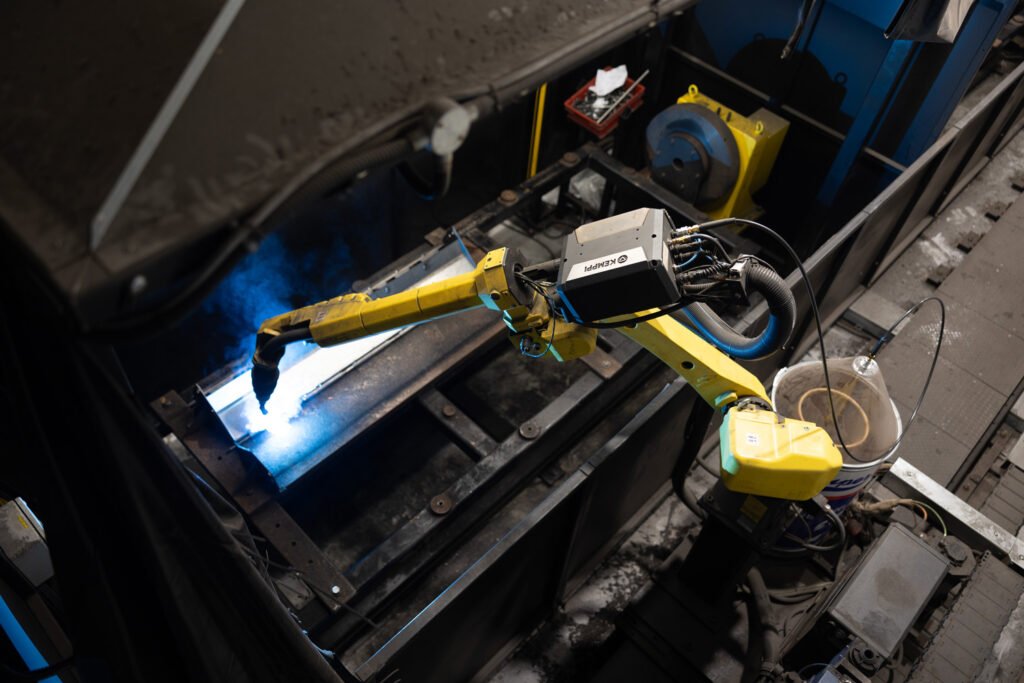
To manage this, robotic cells are often designed so welding time is not held up by handling time. For example, at Unifabs we use a twin-cell setup with a FANUC ARC Mate system running on a 9-metre track with two 3-metre stations. While a component is being welded in one cell, the next is loaded in parallel. This keeps the cycle moving and reduces downtime between welds.
However, this level of efficiency depends on how well the process is prepared before production begins. Read more about the advantages and disadvantages of robotic welding in our FAQs.
Applied production considerations
These core differences influence how both processes are applied in real manufacturing environments.
Setup, programming and production readiness
Manual welding requires minimal setup. Once drawings and fixtures are in place, work can begin quickly. This makes it suitable for prototypes, small repeat batches and assemblies where designs may still change.
Robotic welding requires more preparation. Offline programming, fixture design and validation are completed before production begins. The weld path is defined in advance and proven before release. Any change to geometry, weld access or sequence usually requires reprogramming. For this reason, robotic welding is typically introduced once a design has reached a stable production stage.
This is less about volume alone and more about engineering readiness. Weld access, fixture setup and distortion control all need to be understood before automation becomes efficient.
As Technical Director Matt Grealy explains:
“Robots are only as good as what you feed them. If the process is stable and the fixtures are right, they’ll run all day. If the process isn’t stable, you’ll just be repeating the same problem faster.”
In practice, programmes are always proved out and validated before release to ensure the process is stable before production.
In larger fabricated assemblies, this level of preparation is often supported by a full design for manufacture service before production release. An example of this approach can be seen in a rear casing project for a mower system.
The original design used a composite material but it was causing supply and performance issues for the OEM. Through a full design for manufacture review, Unifabs re-engineered the part for sheet metal production utilising robotic welding.
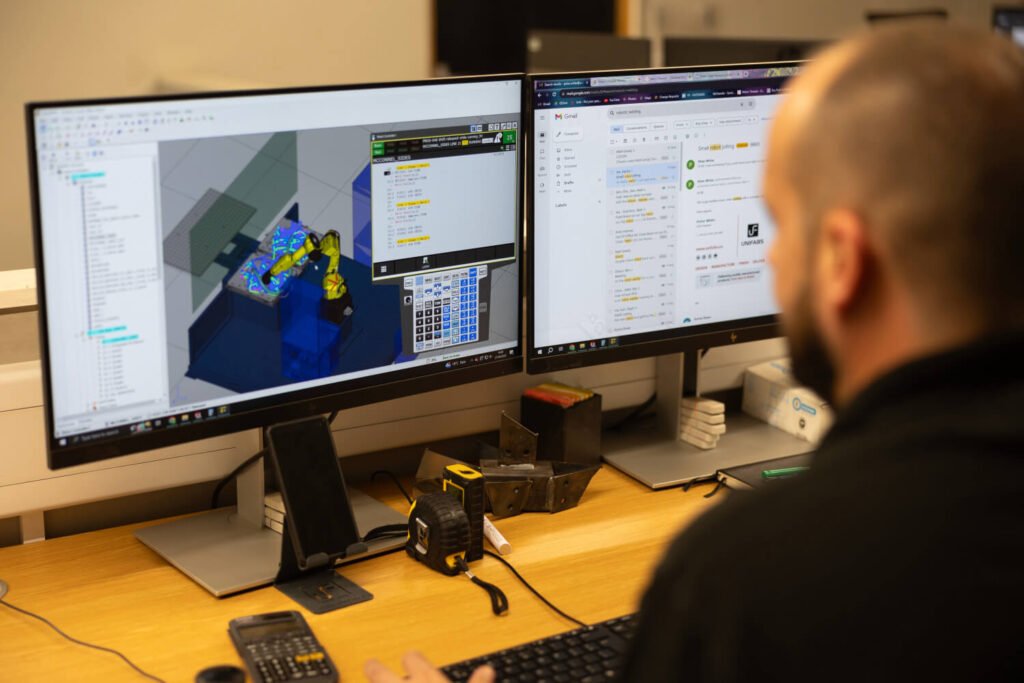
The design was refined to simplify forming and jigs were designed to enable robotic welding, supporting consistent welding and positioning. Offline programmes were created from CAD models and simulated before release. This ensured welds could be completed in a defined sequence, with consistent torch access and repeatable positioning across the assembly.
This combination of redesign, fixturing and robotic welding allowed the component to move from a complex manual build into a stable, repeatable production process.
Component size, weight and handling
Once production is established, component size and handling also influence which method is most practical.
Larger components can often benefit from robotic welding systems where fixtures support repeatable positioning and reduce manual handling. However, very large or complex geometries may still favour manual welding where access or repositioning within a fixed cell becomes restrictive.
In these cases, operator flexibility becomes the deciding factor.
At Unifabs, this is managed through a mixed capability setup. Our twin-cell FANUC ARC Mate system and single FANUC AM100iD cell allow us to handle components up to 3m x 1.5m and 1000kg, alongside MIG, TIG, spot and laser welding services for fabrications that require greater access flexibility.
Weld quality and repeatability
Robotic welding provides consistent execution once validated. Each robotic welding cycle repeats the same movement and process parameters, minimising batch-to-batch variation. This is especially useful when several welded elements must align within a larger assembly.
Manual welding quality depends more on the consistency of the operator. Skilled, experienced welders produce high-quality results, but natural variation between shifts and workloads can introduce small differences across parts. These variations are often acceptable individually, but they become more important when assemblies rely on consistent positioning across several welded features.
When to use robotic welding vs manual welding
Taken together, these differences determine where each process is most effectively applied. In practice, robotic and manual welding are not competing processes. They are used alongside one another depending on what the job requires.
Manual welding is typically used for:
- Prototypes and early-stage production
- Smaller repeat batches
- Complex geometries requiring access flexibility
- Jobs where design changes are still anticipated
Robotic welding is typically used for:
- Repeat production runs with stable, repeatable designs
- Subcontract manufacturing with recurring batches
- Assemblies requiring consistent weld positioning
- Higher volume work where repeatability justifies automation
Not every design, once finalised, will progress to robotic welding. Suitability depends on geometry, repeatability requirements and whether automation improves overall manufacturing stability.
Cost and production economics
Manual welding has a low initial cost and is well suited to prototypes, short runs and repair work.
Robotic welding requires higher upfront investment in equipment, programming, fixtures and setup. However, it reduces cost per part through consistency and repeatability.
As volume increases, these fixed setup costs are spread across more parts, improving efficiency over time. In many cases, the main benefit is not welding speed, but reduced rework and fewer inconsistencies between batches.
Health and safety in welding
One of the key advantages of robotic welding systems relates to operator safety.
Manual welding exposes operators directly to arc radiation, fumes and heat, along with physical strain depending on part size and position.
Robotic welding removes the operator from the immediate welding environment. The role shifts to loading, unloading, operation and process monitoring from outside of the welding cell. This makes the working environment more controlled and reduces exposure to welding hazards such as arc radiation and fumes.
Using robotic and manual welding together
In most fabrication environments, robotic and manual welding sit within the same overall workflow.
Manual welding supports early development, prototyping, smaller repeat batches and complex assemblies. Robotic welding supports repeat production where stability and consistency have been achieved.
At Unifabs, manual MIG, TIG, spot and laser welding support development work, prototyping and repeat batch fabrication, while robotic welding services support repeat production where consistency, throughput and component suitability make automation more efficient.
Having both processes available allows components to move from prototype through to full production with a single manufacturer, without losing continuity between design and manufacture.
Summary
When considering robotic welding vs manual welding, each serve different but complementary roles within fabrication. Manual welding provides flexibility where designs are still evolving or where access and variation are part of the process. Robotic welding delivers repeatability and consistency once a design is stable and production conditions are defined. The decision is not about choosing one over the other. It’s about using the most appropriate method, at the right stage, based on the part, consistency and production requirements. Both contribute to reliable, efficient and scalable fabrication outcomes when applied correctly.
Robotic welding vs manual welding: key differences
The key differences between robotic welding and manual welding come down to flexibility, repeatability, setup requirements and production suitability. Manual welding offers greater flexibility and adaptability, while robotic welding delivers higher consistency and repeatability in production.
| Area | Manual welding | Robotic welding |
|---|---|---|
| Flexibility | High adaptability during welding, suitable for design variation and complex access | Limited once programmed, best suited to fixed and repeatable designs |
| Repeatability | Dependent on operator and conditions | Highly consistent cycle-to-cycle repeatability |
| Setup requirement | Minimal setup, quick to deploy | Higher setup including programming and fixtures |
| Best suited for | Prototypes, development work, and variable assemblies | Repeat production runs with stable, repeatable designs |
| Process variation | Natural variation expected | Variation tightly controlled within programmed parameters |
| Production focus | Flexibility over consistency | Consistency and repeatability over flexibility |